Where the show comes from
Puy du Fou: from Vendée to Toledo
How a French night spectacle with volunteer actors became Puy du Fou España and El Sueño de Toledo, with the dates that matter.
Choose a date for the night show ↗Quick answer
Puy du Fou began in Les Epesses, in France's Vendée, where the Cinéscénie night show first played in June 1978. The Spanish park, Puy du Fou España, began in 2019 with El Sueño de Toledo and grew to five shows and four villages in 2021. The Spanish park belongs to the same association as the French original, but its stories are Spanish.
A ruined castle in the Vendée
The idea belongs to Philippe de Villiers, who conceived it in 1977. On 13 June 1977 he found the ruins of a Renaissance castle at Les Epesses, in the Vendée department of western France. From that discovery came a show staged by and for local people, and eventually a business and a theme park.
The Cinéscénie, 1978
The Cinéscénie began in June 1978. It was not very successful at first, but it grew through its first season. Its cast are volunteers from the local villages, children included. That detail explains the brand's tone: a night show on a large outdoor stage with a cast drawn from one region, telling the history of that region.
The park around it
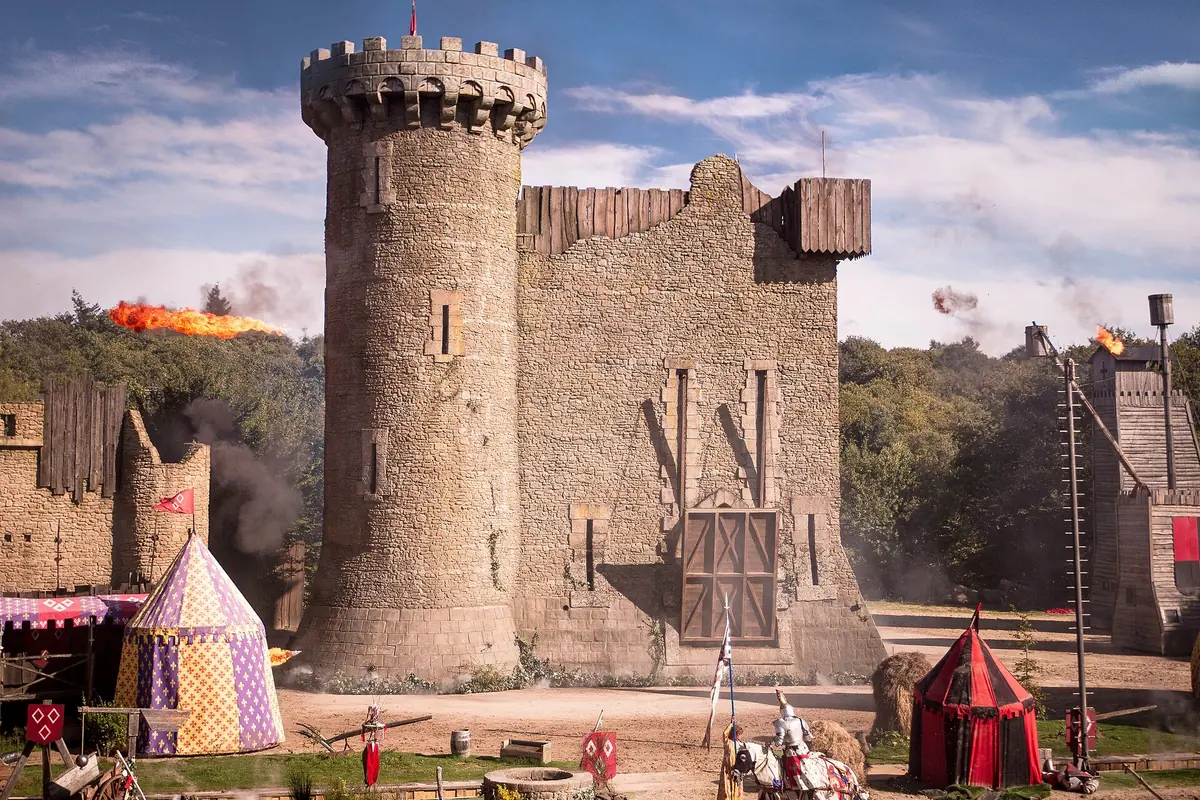
The Grand Parc opened near the Cinéscénie in 1989. Puy du Fou has since collected prizes for its shows. Wikipedia lists Best European theme park from the Parksmania Awards in 2013, the Applause Award in 2014, a Hall of Fame Award in 2017 and a THEA Award for Best Live Show for Le Mime et l'Étoile in March 2024. Its owner is the Association du Puy du Fou.
How it reached Toledo
Puy du Fou España began in 2019 with El Sueño de Toledo, staged beside the city. It expanded in 2021 to five shows and four villages, and the park describes its shows as based on the history of Spain. The Spanish night show kept the French idea, a big outdoor stage, a cast of actors, riders and acrobats and a story told in sequence, and replaced the French history with Spanish. The park stands on the outskirts of Toledo, in Castile-La Mancha, and belongs to the same French association as the original.
The other shows in the Spanish park
The park runs daytime shows as well. Its pages list A Pluma y Espada, a swashbuckling show about Lope de Vega, El Último Cantar, about El Cid, Cetrería de Reyes, a falconry competition between Abd al-Rahman III and Fernán González, and El Misterio de Sorbaces, set in the Visigothic period. El Sueño de Toledo is the one the park labels as its night show, so it is the one that plays after dark. The park's pages also list an immersive show, Allende la Mar Océana, El Tambor de la Libertad among the daytime shows, and five villages, including El Arrabal, where the restaurant area is.
Read next: El Sueño de Toledo tickets
Awards the park claims
The show's own page lists the international awards it has won. These are the park's own statements, so treat them as a description of how it presents itself, not as an independent ranking. What visitors say is more useful: the show's reviews on the booking page are strong, and some reviewers mention long lines at the gates.
Who this isn't for
If you came to Spain for museums and old stones, a theme-park night show is a detour. Puy du Fou is entertainment built on history, with machinery, projections and horses, and it has no connection with the Toledo of the guidebooks beyond the story it tells. It suits families, groups and anyone who likes large outdoor shows. For the city itself, spend a day there first.
Read next: Toledo before the night show
Frequently asked questions
Is Puy du Fou España the same as the French park?
It belongs to the same association and uses the same idea of large outdoor historical shows, but its stories are Spanish and its cast and sets are separate.
When did the Spanish park start?
Wikipedia dates the beginning to 2019 with El Sueño de Toledo, and the expansion to five shows and four villages to 2021.
Are the actors volunteers?
At the French Cinéscénie, yes: the cast are volunteers from the local villages. The ticket describes the Spanish show as 200 actors, riders and acrobats.
Sources